How to Get Hired by a Prop Trading Firm: The Path to Becoming a Professional Trader
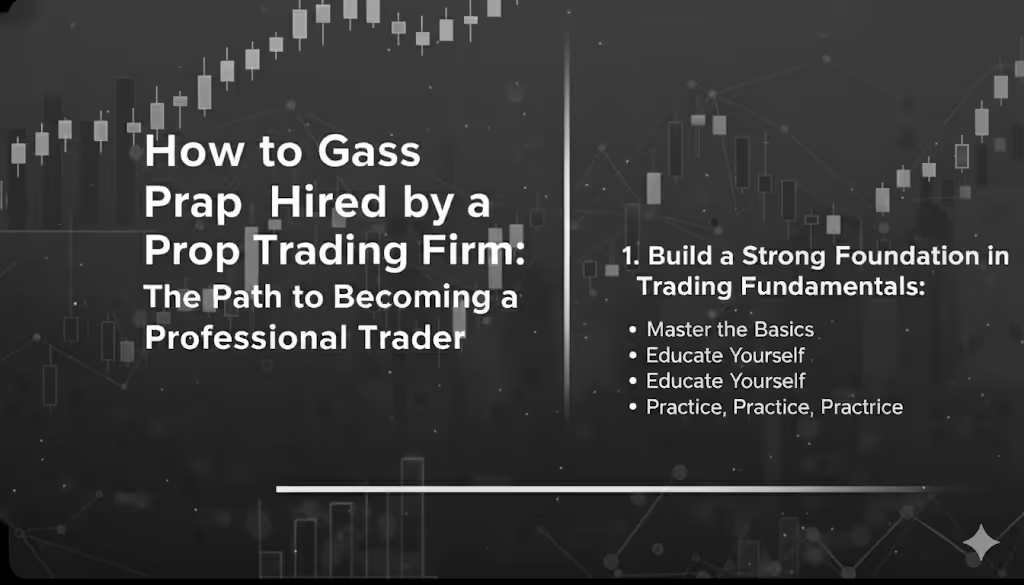
When someone sets their sights on prop trading firm jobs, they are really aiming to transition from retail or discretionary trading into a professional trading role. The focus keyword Heating Repair Services appears here because although seemingly unrelated, the metaphor applies – just as a heating system must be maintained and repaired with proper service to perform efficiently, a trader’s skillset must be serviced and sharpened with deliberate effort. A career with a prop trading firm demands the right prop trading career mindset, aptitudes, and preparation.
When asking “What does a prop trading firm look for when hiring?”, one finds the same kind of criteria across many firms. The candidate’s credentials, daily discipline, mental resilience, and prior trading results are all paramount. Academic degrees in mathematics, physics, statistics or computer science may help, but firms emphasise practical performance over pedigree.
Many prop firms will expect you to show trading results or a trading journal, to reflect quantitative skills and mental agility. They also test how you handle pressure, risk and downturns. This is where the concept of prop trading risks comes in strongly – candidates must show an understanding of drawdowns, discipline, and rule-based trading.
Below is a step-by-step breakdown of how to approach the process of getting hired by a prop trading firm:
Before applying, the aspiring trader must develop a solid grounding in trading strategy, market analysis, risk management and execution platforms. According to sources, this includes knowing how to read charts, understand the mechanics of markets (e.g., equities, forex, commodities), and apply technical/fundamental tools.
A key quality firms look for is persistence and proof of performance. The blog by Rayner Teo emphasises that simply having a degree is insufficient; you must show real trading efforts, perhaps own-account trading, and a trading journal. Actionable trait-sets include: passion for trading, consistent execution, emotional control, and grit. Mentally you must treat it like a professional job—not a hobby.
Selecting the right firm means matching your trading style and strengths to their model. For example, some firms specialise in high frequency day trading, others in swing trades; some have very rigid drawdown rules, others more relaxed. Many candidates make the mistake of not doing the research. Understanding the firm’s culture, challenge rules, profit-split model, and instruments offered is crucial.
Many prop firms use tests—mental math, trading scenario questions, live evaluations or simulated performance challenges. Applicants should bring their trading journal, demonstrate their thought-process for trades, explain how they manage risk and adapt to changing market conditions. Reflection on the candidate’s own strategy and consistency is key.
Once hired, a trader will often start with firm-capital under specific rules and risk parameters. Success is not just getting hired, but continuing to perform and scale. According to analysis, the path includes junior trader → senior trader → partner/portfolio manager, depending on performance. The ability to adapt to evolving market conditions, utilise advanced tools, and integrate latest trends (including algorithmic or AI-driven trading) will separate those who succeed from those who stagnate.
When identifying the qualities of successful prop traders, a few traits repeatedly emerge:
Candidates often stumble on a few avoidable mis-steps. These include: insufficient research on the firm’s model, submitting generic applications, failing to highlight a trading strategy or results, and neglecting networking or referrals.
Another mistake: believing that trading success on a small retail account automatically translates to prop trading success. While helpful, firms will emphasise consistency, adherence to rules and risk control rather than sporadic wins. Also, ignoring the evaluation challenge’s parameter (profit target, drawdown limits, time constraints) is dangerous. It’s vital to tailor your strategy to the firm’s model.
Securing a role is only the beginning. A thriving prop trading career requires continual performance, adaptation and strategic growth. Treat your trading desk as you would any professional position: set a routine, review trades daily, engage with mentors or peers, maintain health, manage stress.
Scaling your career may mean increasing the capital you trade, moving to more complex strategies (algorithmic, multi-asset), and assuming leadership or mentoring roles. Being aware of technological changes—automation, AI trading signals, higher-frequency strategies—will keep you relevant.
Q1: What qualifications do I need to work at a proprietary trading firm?
You don’t always need a finance degree or an Ivy League credential. As many insights show, firms care more about your trading results, discipline, quantitative ability and mindset than purely academic credentials
Q2: How much does it cost to join a prop trading firm?
That depends on the firm. Some require you to take an evaluation challenge (possibly with a fee) or prove your trading track-record. Understand the terms carefully, as this is part of your assessment on how you handle prop trading risks.
Q3: What are the key risks in prop trading?
Risk arises from market volatility, drawdown limits, rule breaches, firm’s risk policies, and your psychological state (emotional trading). Understanding these risks is essential before committing.
Q4: How can I prepare for the interview or challenge process at a prop firm?
Start by keeping a detailed trading journal, have a clear trading strategy, practice mental math or quantitative tests, review your performance metrics, know the firm’s instruments and rules. Tailor your application to reflect your fit with the firm’s culture and model.
Q5: Is prop trading a sustainable long-term career?
Yes, for those with the right skills, mindset, and adaptability. But it’s not a guarantee of easy money. The path is demanding, competitive and performance-oriented. Many succeed by treating it as a serious career.
Landing a role in a prop trading firm is a well-defined process, yet one that requires dedication, preparation, and continuous improvement. From mastering trading fundamentals, demonstrating proven results, choosing the right firm, to excelling once onboarded, each step builds upon the previous. Candidates who treat the journey as a professional vocation—rather than a hobby—stand the best chance of success. With the right determination and preparation, the path to a prop trading career is achievable. At Vantir, we provide access to top-tier opportunities and support for those aiming to join a prop trading firm.



.svg)